Transforming the Reader Search Experience Through an AI Agent
Status
Launched in Q1 2025
Company
The Washington Post
Team
PM (1), Design Lead (myself), Engineers (4)
Project Objective
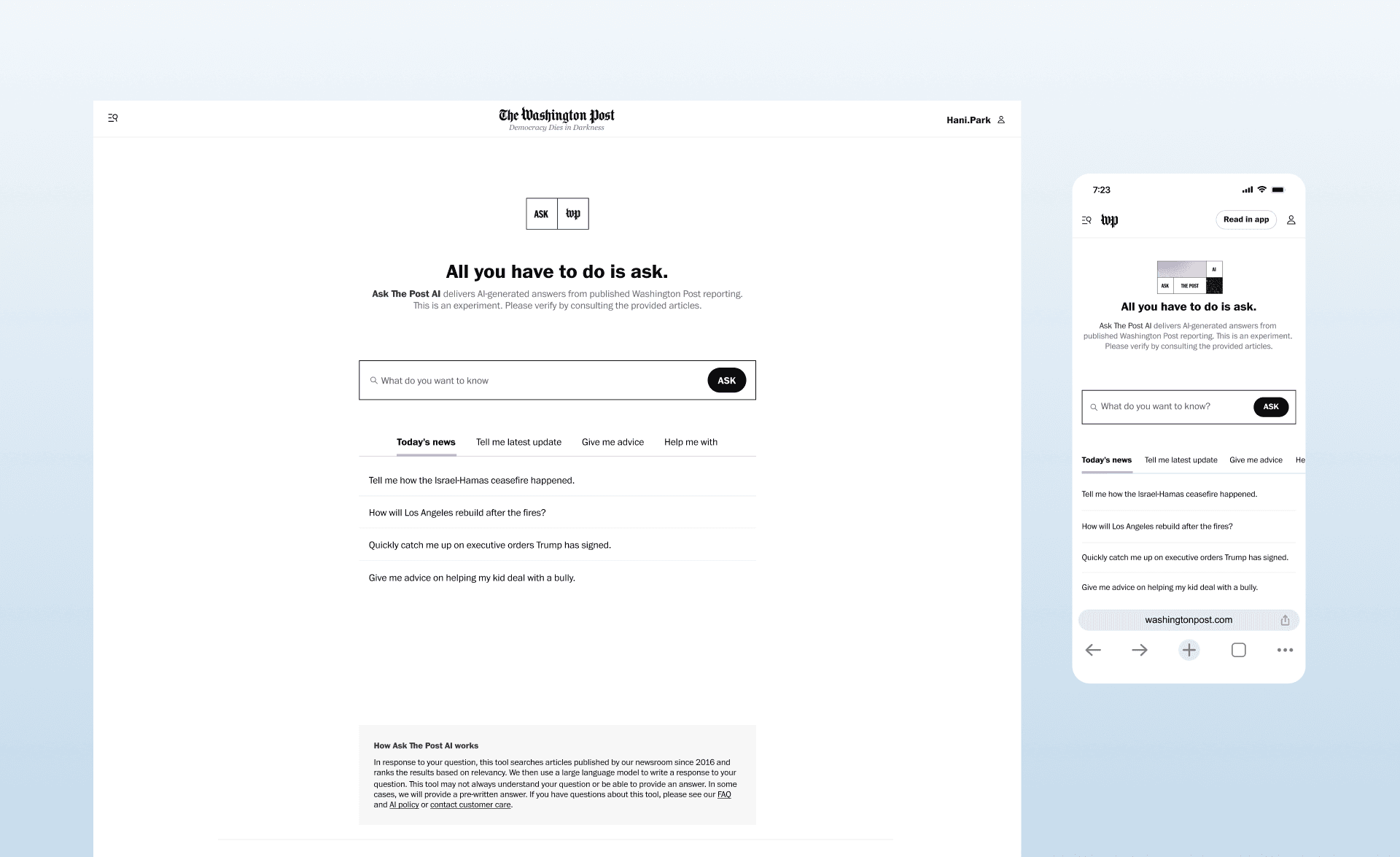
Ask The Post (ATP) is The Washington Post’s AI-powered agent that lets readers query our journalism in natural language. My role was to design how this agent interacts with users, making the experience intuitive, trustworthy, and engaging.
Problem
Readers often struggle to navigate the Post’s vast archive. Search is keyword-heavy, and many don’t know how to phrase queries to get meaningful answers.
The early ATP landing page suggested 10 sample questions, but they were all news-focused. This left out opportunities to guide users toward service-oriented tasks like planning, how-to, or everyday decision-making.
Opportunity
Design Approach
We had a chance to reposition ATP as not only a news explainer, but also as a personal assistant for service journalism.
By introducing task-based prompts alongside news prompts, we could show users the full breadth of what the AI agent could do.
My design approach centered on making the AI agent feel intuitive, trustworthy, and useful.
Ecosystem mapping → Designed the overall ecosystem of how the AI agent would work within the platform, creating a journey map of user touchpoints.
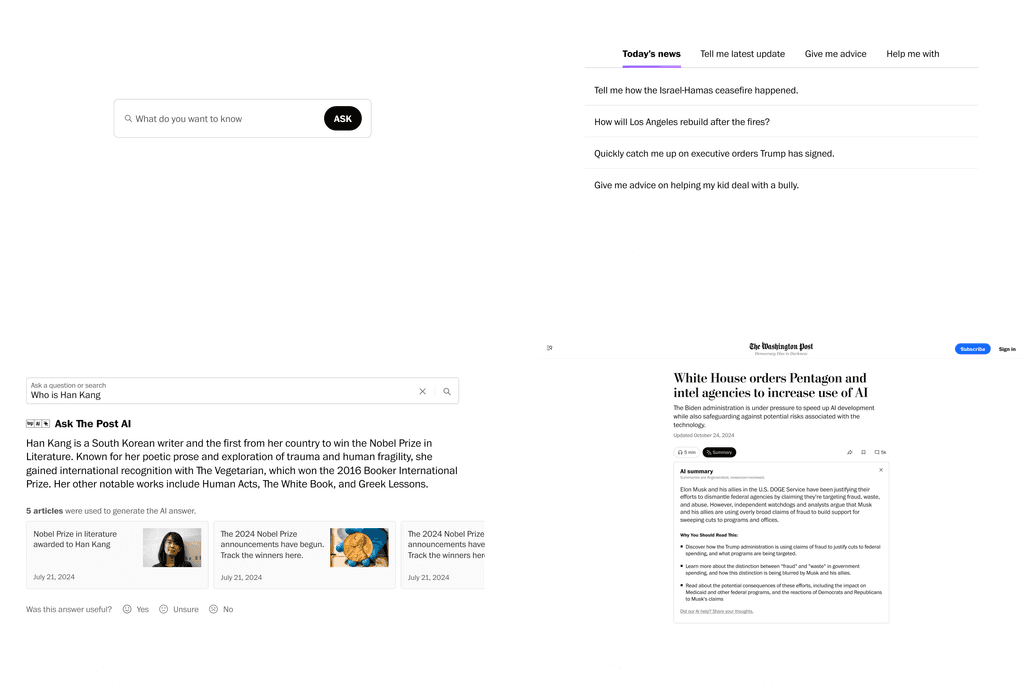
Prompt design → Added 3–4 task-based prompts (e.g., “Help me plan a Thanksgiving menu”) that showcased service journalism.
UI distinction → Created a visual style that differentiated task prompts from news prompts while keeping them part of the same system.
Collaboration → Partnered with product, engineering , and design colleagues to shape content strategy, prompt selection, and interface details.
Flexibility → Built editing capability so the newsroom could update prompts without design or engineering support.
Opportunity
We had a chance to reposition ATP as not only a news explainer, but also as a personal assistant for service journalism.
By introducing task-based prompts alongside news prompts, we could show users the full breadth of what the AI agent could do.
Design Approach
My design approach centered on making the AI agent feel intuitive, trustworthy, and useful.
Ecosystem mapping → Designed the overall ecosystem of how the AI agent would work within the platform, creating a journey map of user touchpoints.
Prompt design → Added 3–4 task-based prompts (e.g., “Help me plan a Thanksgiving menu”) that showcased service journalism.
UI distinction → Created a visual style that differentiated task prompts from news prompts while keeping them part of the same system.
Collaboration → Partnered with product, engineering , and design colleagues to shape content strategy, prompt selection, and interface details.
Flexibility → Built editing capability so the newsroom could update prompts without design or engineering support.
Journey Mapping the AI Experience
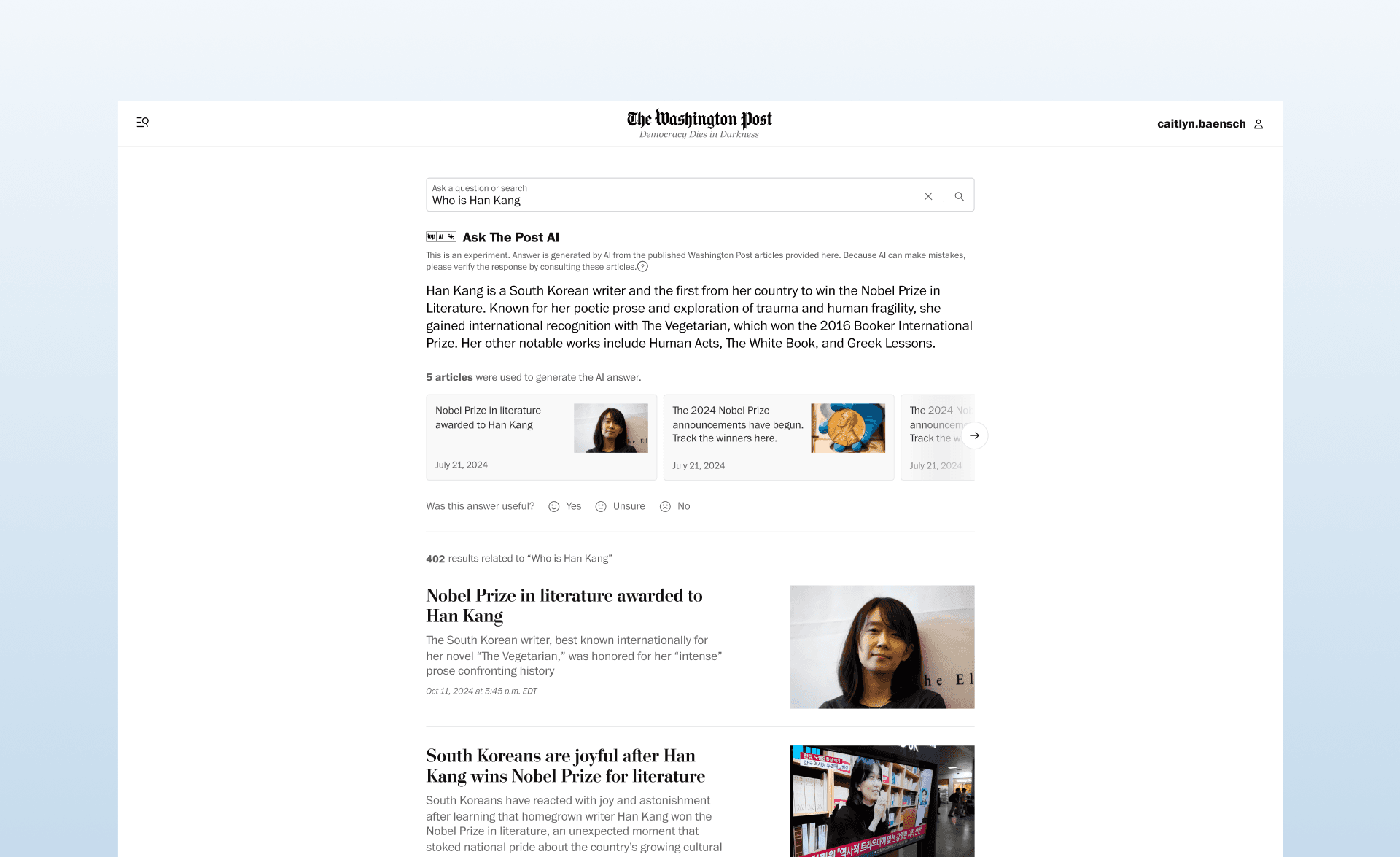
I designed a journey map to capture where and how users interacted with the AI agent across the platform. By aligning these touchpoints with user needs and business goals, we streamlined the flow, reduced drop-offs, and created a more engaging and scalable AI-driven experience.
Delivery & Outcomes
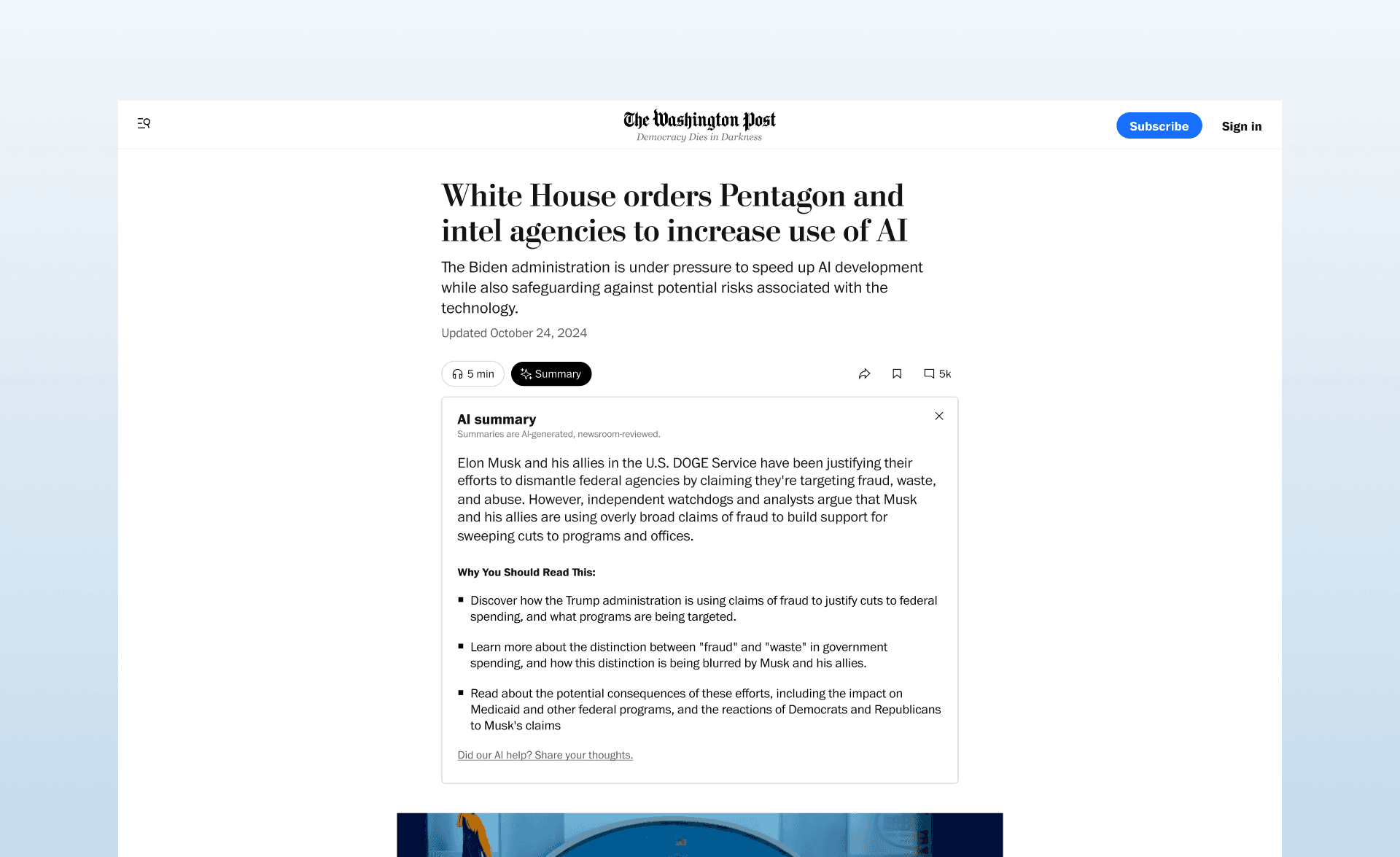
Validated that ATP could scale beyond news, laying the foundation for future expansion into apps and new entry points.
Higher click-through on source articles: The percentage of users who clicked on linked articles after reading AI-generated summaries rose by 8.3%.
Improved reader sentiment: Positive user feedback increased to 53%, while negative sentiment dropped—indicating that the experience felt more relevant and useful.
Recognized team impact: Our design updates were credited in internal reports as a key driver of sustained growth in article engagement and feature adoption.
My design approach centered on making the AI agent feel intuitive, trustworthy, and useful.
Prompt design → Added 3–4 task-based prompts (e.g., “Help me plan a Thanksgiving menu”) that showcased service journalism.
UI distinction → Created a visual style that differentiated task prompts from news prompts while keeping them part of the same system.
Collaboration → Partnered with product, engineering , and design colleagues to shape content strategy, prompt selection, and interface details.
Flexibility → Built editing capability so the newsroom could update prompts without design or engineering support.
🎨 Open to work!
Excited for new opportunities. Feel free to reach out to learn more about my design process and approach.
Journey Mapping the AI Experience
User pain points guided me in mapping each step from entry to outcome, making the experience easier for readers to understand and engage with.
Transforming the Reader Search Experience Through an AI Agent
Status
Launched in Q1 2025
Company
The Washington Post
My role
Strategy, Research, Design